
Services
Spray Foam Insulation
Spray foam that insulates and air-seals in one application — for roof decks, rim joists, crawl spaces and the spots nothing else can reach.
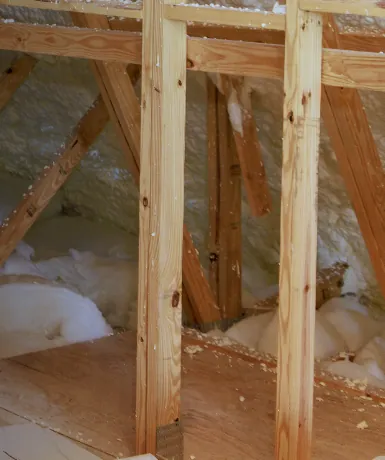
Spray foam does two jobs in one pass: it insulates, and because it expands into every crack and irregular surface before it cures, it air-seals as it goes. That makes it the right answer in the places fibrous insulation struggles — the underside of a roof deck, the rim-joist band at the top of your foundation walls, odd-shaped crawl-space walls, and cathedral ceilings.
Foam is a precision material, not a default. It costs more per area than fiberglass, and in a big open attic floor, blown-in usually wins on value. We'll tell you plainly where foam earns its price in your home and where it doesn't — that honesty is built into the assessment.
What's included
- Insulation + air seal in a single application
- Roof-deck application for finished attics and cathedral ceilings
- Rim joists sealed and insulated — a top source of winter drafts
- Conforms to irregular, hard-to-reach cavities
- Closed-cell options where moisture resistance matters
Book Your Free Assessment
Tell us what you need and we'll call you back to confirm. Rather talk now? (855) 640-0404 — answered 24/7.
How it works
Our Process
Assess the assembly
We check the surface, moisture picture and ventilation design — foam changes how an assembly breathes, and that has to be planned, not discovered.
Prep & protect
Surfaces are cleaned and everything that shouldn't be foamed is masked and protected.
Spray in passes
Foam is applied in controlled lifts to the specified thickness and allowed to cure between passes.
Inspect
Thickness and adhesion are checked across the job; you get photos of the finished work.
Questions
Spray Foam Insulation — FAQs
In the right places, yes — rim joists, roof decks and leaky crawl spaces repay it because it seals air leaks that fiberglass can't. In a wide-open attic floor, usually not. Your assessment will show you the comparison for your house, in writing.
We ask that the work area be vacated during application and for a curing window afterward, and we'll give you the exact re-entry timing for the product used before the job starts.
Closed-cell is denser, adds rigidity and resists moisture — common at rim joists and below grade. Open-cell is softer, excellent for sound and roof decks in the right assembly. The assessment determines which belongs where.
It can — a foamed roof deck creates an unvented attic assembly, which is a legitimate design when done correctly — but it must be planned as a system. We'll explain exactly what changes before quoting it.