
Services
Blown-In Insulation
Loose-fill fiberglass or cellulose blown to a measured depth — it fills around wires, pipes and joists where batts leave gaps.
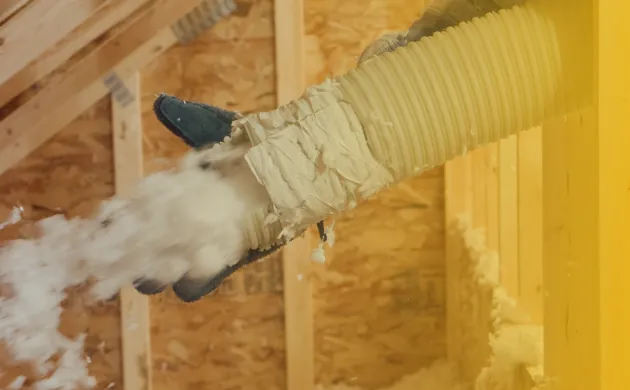
Batts are rectangles; attics aren't. Every joist, wire run, pipe and cross-brace is an obstacle a batt has to be cut around — and every cut is a chance for a gap. Blown-in insulation flows instead: a hose-fed stream of loose-fill fiberglass or cellulose that settles into a continuous blanket, wrapping every obstruction and filling the odd corners batts leave open.
Depth is everything with loose fill, and depth is measured, not eyeballed. We install to a target depth verified with rulers across the attic, accounting for settling, so the coverage you pay for is the coverage you actually have — corner to corner, including the far edges most installers short-change.
What's included
- Continuous blanket — no seams or batt gaps around obstructions
- Fiberglass or cellulose, chosen for your attic and your goals
- Depth verified with rulers across the whole floor, not spot-checked
- Ideal for topping up existing insulation to a proper depth
- Also available for wall cavities (dense-pack) where suitable
Book Your Free Assessment
Tell us what you need and we'll call you back to confirm. Rather talk now? (855) 640-0404 — answered 24/7.
How it works
Our Process
Assess & seal
Existing material is measured, air leaks are sealed, and eave baffles go in before a single bag is opened.
Set the depth
Depth markers are placed across the attic so the target is visible from the hatch to the farthest corner.
Blow it in
Loose fill is blown evenly, working from the far corners back toward the access, around every duct and pipe.
Verify
We re-check depth at the markers and photograph the finished blanket for your records.
Questions
Blown-In Insulation — FAQs
Loose fill settles somewhat after installation — that's expected physics, and it's why we install to a settled-depth target, not the fluffed depth on day one. Properly installed, it then stays put for decades.
Both insulate well when installed to the right depth. Fiberglass resists moisture and doesn't settle as much; cellulose is a recycled product with excellent air-flow resistance. We'll lay out the honest trade-offs for your attic at the assessment.
Yes — a blown-in top-up over sound existing batts is one of the most cost-effective upgrades there is. The old layer stays as the base; the new blanket seals its gaps and brings the total depth up.
The hose run is contained and the work happens in the attic. We protect the access route and clean up before we leave — you'll find insulation in the attic, not in your hallway.