
Blog · 2026-11-12
Blown-In vs. Batt Insulation: Which Belongs in Your Attic?
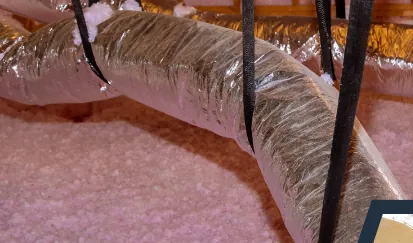
It's the most common question in insulation, and it has a genuinely unsatisfying answer: it depends on the attic. Both materials insulate the same way — trapped air pockets resisting heat flow — and both can hit the same R-values. The differences are in coverage, installation quality, and what each does with the obstacle course that is a real attic floor.
Where batts struggle
A batt is a rectangle. Your attic floor is not: it's joists every 16 inches, cross-bracing, wire runs, plumbing vents, duct trunks and junction boxes. Every obstacle means cutting, and every cut is a chance for a gap or a compressed section — and compressed fiberglass loses the air pockets that make it work. In skilled hands, fiberglass batt insulation can be fitted beautifully. In a hurry, it's a quilt of good intentions and cold stripes.
Where blown-in shines
Blown-in insulation flows. The loose-fill blanket wraps every joist and pipe, fills the odd corners, and — critically — presents one continuous surface with no seams. It's also the natural way to top up an existing attic: the new blanket seals the gaps in whatever is already there. Its weakness is the opposite of the batt's: there's nothing to see or grab, so the installer must be disciplined about depth. We set depth markers across the attic and verify against them, because blown-in installed by eyeball is how homeowners end up with half of what they paid for.
The settling question
Loose fill settles after installation — a fact of physics, planned for by installing to a settled-depth target. Cellulose settles more than blown fiberglass; both are accounted for in the depth specification. Batts don't settle, but they can sag if poorly supported in floors and ceilings. Neither is a reason to choose one over the other; both are reasons to hire installers who talk about it unprompted.
Our honest scorecard
Simple, rectangular, wide-open attic floor: either works — batts can be the economical choice. Chopped-up attic with ducts, pipes and knee walls: blown-in, almost every time. Walls and floors: batts (or dense-pack), because gravity has opinions about loose fill in vertical cavities. Topping up what's already there: blown-in over the top. And in every case, whichever material wins, air sealing happens first — the best material in the world can't fix a leak it was never meant to address.
Not sure which your attic wants? That's literally what the free assessment is for. Call Eagle Insulation Services at (855) 640-0404.
Want us to look at your attic?
Book a free assessment — depth measured, leaks photographed, options in writing.